The DISE method of prioritisation is a productivity process born from 20+ years of working experience across financial services, business analysis, project management, change management, coaching and staff management.
This has created a structured prioritisation method combining four key principles:
- Deadlines – Establish clear time constraints for tasks to ensure accountability and prevent procrastination.
- Information – Gather relevant details to make informed decisions, reducing uncertainty and improving efficiency.
- Sizing (T-shirt Sizing) – Categorise tasks by effort or complexity (e.g., XS, S, M, L, XL, XXL) to streamline workload assessment.
- Eisenhower Matrix – Prioritise based on urgency and importance, helping to focus on impactful tasks while avoiding distractions.
The Power of Deadlines
Deadlines play a crucial role in productivity and motivation. Daniel Pink (2011) highlights the “uh-oh effect”, where looming deadlines increase the perceived importance of a task, pushing individuals to focus and complete it. This psychological trigger helps people prioritise urgent work and avoid distractions.
Additionally, deadlines combat procrastination by creating a sense of urgency. Without a clear time constraint, tasks can linger indefinitely, leading to delays and inefficiency. Research suggests that deadlines force action by applying psychological pressure, making individuals more likely to engage in meaningful work rather than postponing it.
Parkinson’s Law states that “work expands to fill the time available for it’s completion.” (Parkinson, 1958). Shorter deadlines sharpen focus, pushing us to eliminate distractions and work with greater intensity.
Deadlines are deployed as a fundamental part of the D-I-S-E method, and either need to be clear and known, or set by you to drive action and completion.
Information: Defining what needs to be Delivered
Ensuring that enough information is agreed upon and requirements are confirmed before moving forward with a task is crucial for efficiency and success. You should assess whether you have this, and if not, work to gather it before committing a lot of time to a task.
I am a big fan of the MoSCoW method, developed by Dai Clegg in 1994 while working at Oracle. MoSCoW is now widely used in Agile project management, and helps prioritise requirements by categorising them into:
- Must-Have – Essential for the task or project to function.
- Should-Have – Important but not critical.
- Could-Have – Nice to include if time/resources allow.
- Won’t-Have (for now) – Deferred for future consideration.
Structured approaches like this, and the Minimum Viable Product (MVP) ensures that only the most critical elements are addressed first, preventing scope creep, wasted effort, and managing expectations for lower-priority items.
By focusing on the core requirements, teams and individuals can reduce complexity, validate ideas quickly, and iterate efficiently.
Sizing – T-Shirt Sizing: Light Estimation
Through my years working as an analyst and in project management, I have found T-shirt sizing has been the most efficient and effective method of estimating effort.
It is a relative estimation technique with roots in Agile project management, used to assess the effort or complexity of tasks. Inspired by universally known clothing sizes, instead of assigning numerical values, tasks are categorised into sizes like S, M, L, XL and then related to the information at hand and past experience of similar tasks.
This makes it easier to compare workload without getting lost in precise calculations. Although used in software development, it’s extremely scalable, and also used in marketing, design and even operations. This makes it perfect for the DISE method.
Benefits of T-Shirt Sizing
- Simplicity & Intuition – Everyone understands clothing sizes, making it an accessible method for teams and individuals.
- Quick Estimation – A lightweight, flexible way to estimate work, helping gauge effort without deep analysis. This speeds up planning.
- Reduces Bias – Focused on relative effort rather than absolute time estimates, minimising unrealistic expectations.
- Supports Agile Planning – Helps balance workload effectively in sprint cycles, and is ideal for individuals building their own work plans.
The Eisenhower Matrix: Focus on Urgency & Importance
The Eisenhower Matrix is a time management tool inspired by former U.S. President Dwight D. Eisenhower, that helps prioritise tasks based on urgency and importance.
The Four Quadrants
- Do It (Urgent & Important) – Tasks that require immediate attention, such as deadlines or crises.
- Defer / Schedule (Important but Not Urgent) – Tasks that contribute to long-term goals but don’t need immediate action.
- Delegate (Urgent but Not Important) – Tasks that need to be done soon but can be assigned to someone else.
- Drop It (Neither Urgent nor Important) – Tasks that don’t add value and can be eliminated.
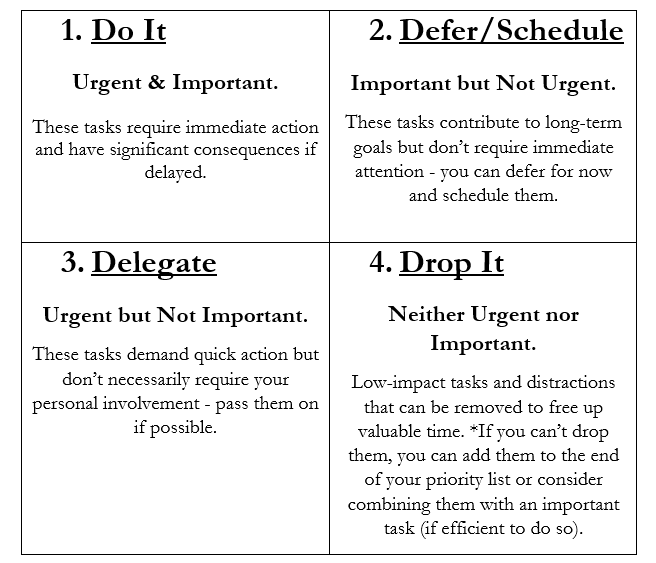
Armed already with deadlines, information, and sizing/complexity, this framework helps individuals and teams define their most urgent and important tasks and focus on what truly matters, reducing stress and improving efficiency.