Most meetings shouldn’t exist, because most of them were never meant to be meetings to begin with. They were emails wearing a calendar invite, status updates dressed up as collaboration, all born from habit and organisational culture.
Calendars across every industry are packed with them. They’re back to back and wall to wall, leaving professionals everywhere ending their day exhausted, behind on real work, and wondering why the most important tasks are lagging behind or have been squeezed in terms of time.
4D-CEO Meeting Test
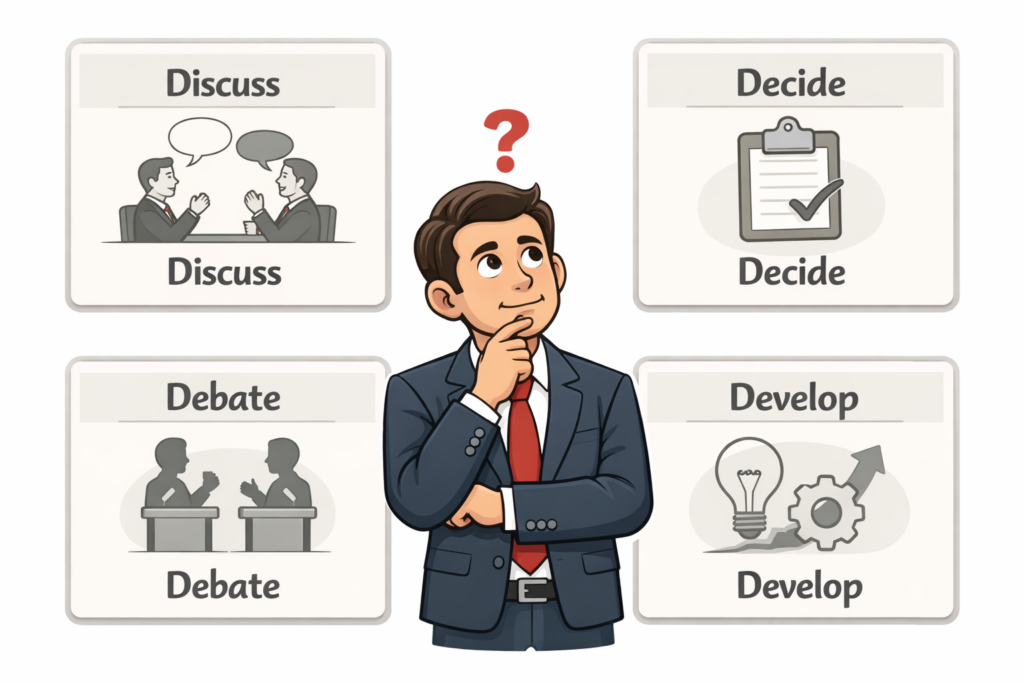
Enter the 4D-CEO Test.
The 4D-CEO Test is a two-screen filter that forces every meeting request to justify its existence before it earns a slot on your calendar. It’s simple, fast, and ruthless in the best possible way. I personally audit my recurring meetings regularly, and at review all thoroughly at least annually. I came across the 4D-CEO Test through Caterina Kostoula‘s book Hold Successful Meetings (link at bottom of page). It is a framework to help leaders to decide whether a meeting is truly needed!
For a meeting to survive, it must survive two questions or ‘filters’. With this in place, many won’t survive both. So, here is the process:
Screen 1: Does it pass the 4Ds?
Before a meeting gets booked, it must have a clear purpose, not a vague one. Beware of terms like “to align” or “to touch base.”, which straight-away fall foul of the 4Ds check. Run your meeting requests through the following four criteria; does it meet any of them?
Decide — A conclusion needs to be reached that requires more than one person’s input. There’s a genuine choice on the table, and the right people need to be in the room to make it.
Discuss — Real two-way dialogue is needed. Presentations and Briefings alone don’t fit this criteria. There needs to be an actual exchange of ideas where the outcome isn’t predetermined and the conversation has genuine value.
Debate — Competing views need to be aired and challenged. This is where tension is productive, different perspectives can be put forward constructively, and a path forward can be agreed.
Develop — People or ideas need to grow through the interaction. Things like coaching conversations, creative workshops, or collaborative problem-solving where the value is in the process, and the output.
If the purpose of your meeting doesn’t clearly fit one of those four categories, it is likely should not be a meeting. Instead it should be a document, an email, a Teams or Slack message, or a voice note. It should be sent, not scheduled as a meeting.
Most status updates fail at the 4D check immediately. So do weekly check-ins that exist purely out of habit and the “just wanted to get everyone together” meeting that could have been a two-paragraph update.
Screen 2: Does it need to be live?
Passing the 4D screen shouldn’t automatically earn a meeting. Even if the purpose is legitimate, and something genuinely needs to be decided, discussed, debated, or developed, you have to ask a second question: does this actually need to happen in real time?
A meeting earns a live slot only if at least one of the following is true:
The topic is emotionally charged: If there’s conflict, sensitivity, or high stakes for the people involved, asynchronous communication creates risk. In this case, tone can get lost, and misunderstandings can compound. Conversations will need a human in them.
The subject matter is genuinely complex: If the nuance can’t be captured in writing or the back-and-forth is essential to reaching clarity, real-time dialogue earns its place.
The decision is hard to reverse: Irreversible decisions need extra care. When you can’t easily undo a choice, the friction of gathering people in a room is worth it. This is because the cost of getting it wrong is higher than the cost of the meeting itself.
If none of those conditions are met, the meeting can almost certainly be handled asynchronously and therefore more efficiently (great, more time back in your diary!).
The Real Cost of a Bad Meeting
We tend to measure meetings by their duration. This can be an hour wasted, thirty minutes lost, but the true cost runs much deeper than the time in the room.
Every unnecessary meeting is also:
- A piece of deep, focused work that didn’t happen
- A decision delayed because real thinking was replaced with discussion theatre
- A signal to your team that their time isn’t protected
- An energy drain that takes the rest of the day to recover from
Research consistently shows that it takes over twenty minutes to return to a state of deep focus after an interruption. A badly timed meeting in the middle of a complex piece of work doesn’t just steal the hour it steals the context on either side of it. That’s hard to recover from, and by the nature of deep and complex work, that will occur several times if any and every meeting request gets into your calendar.
Multiply that across a team of ten, a week of unnecessary meetings, and a year of unchecked calendar bloat, and the cost becomes enormous. This can be an actual cost (work out salary cost of the individual to the organisation per meeting time slot… it can be enormous) in productivity, morale, creativity, and the capacity to do genuinely important work.
Protecting the Calendar Is a Leadership Decision
Calendar culture flows from the top. If leaders accept every meeting invite, their teams will too. If managers fill their days with back-to-back calls, the implicit message is that presence equals productivity. If the calendar is treated as a shared resource that anyone can claim at any time, the most focused and capable people on your team will be the most disrupted because they’re the most in demand. How does the really important work then get done efficiently?
The 4D-CEO Test gives you a language for that protection. Rather than “I’m too busy” which sounds unhelpful, abrasive, and defensive, using the two filters and pushing back or providing an asynchronous alternative is the best bet.
How to Apply It Starting Tomorrow
You don’t need to overhaul your entire calendar to start using this. Try applying the 4D-CEO Test to just one week of meetings. Before accepting or scheduling anything, ask:
1. What is the purpose of this meeting and which of the 4Ds does it serve?
2. If it passes that screen, does it need to be live or is it emotionally neutral, straightforward, and reversible?
If you can’t answer the first question in a single sentence, the meeting isn’t ready. Push back back for a clearer agenda or recommend converting it to an asynchronous communication.
If it passes the first question but fails the second, propose an alternative. This can be something like a shared document, a summary email, a short voice note, or even a Slack or Teams message. Most people, when offered a better, simpler and quicker option, will take it.
Protect the calendar like it’s your most valuable asset, because it is!
Looking for a daily structure that brings the same clarity to your tasks that the 4D-CEO Test brings to your meetings? The DISE Method Daily Journal is built around exactly that principle; filtering what’s urgent, what’s important, and what can wait, before your day begins. Find out more at The DISE Method Daily Journals
Other Links
Interested in more productivity content? Sign up to the Newsletter and receive it direct to your inbox!